Tom Verducci delivers a mix of expert commentary, inside angles and thoughtful perspectives on baseball’s biggest storylines every week.
Want to be included in his new mailbag feature? Email a question to newsletter@si.com.
|
|
|
The AL MVP Race Is Wide Open and Full of Flawed Candidates |
Halfway through the season, the American League is a monument to mediocrity. The Yankees have a run differential of +120. Only three other teams in the league have a positive run differential, none more than the Rays’ +20. The Red Sox, a bad baseball team, are five games out of a playoff spot. The Rangers, a losing team, hold a wild-card spot.
No AL team has made the playoffs in a 162-game season with fewer wins than the 84 of the 1984 Kansas City Royals. We might see two AL teams limbo under that low bar.
The same slow-speed car chase is happening with the AL MVP race, which for the first full season since 2019 will not be won by Aaron Judge or Shohei Ohtani. It was so long ago DJ LeMahieu and Nelson Cruz finished in the top 10 behind the winner, Mike Trout.
The AL MVP race this year is a contest among flawed candidates, many of whom play for losing teams. Of the top 12 players in the AL ranked by WAR, 10 play for losing teams. Cody Bellinger and Miguel Vargas are the lone exceptions.
Only 10 times has a player from a losing team won an MVP, with the last four occasions in the AL coming from the Angels (Ohtani twice and Trout twice). Only three players have won an MVP playing for a team that lost 90 games or more: Trout (72–90 Angels in 2019), Alex Rodriguez (71–91 Rangers in 2003) and Cal Ripken (67–95 Orioles in 1991).
As teams passed the 81-game mark last week, here are the leading contenders for AL MVP, warts and all.
1. Yordan Alvarez, Astros
A DH from a losing team winning MVP? That’s never happened. Ohtani did win MVPs with losing Angels teams in 2021 and 2023, but he also made 23 starts on the mound in each of those years. Alvarez has played only 18 games in the outfield. But Alvarez is the favorite because he is best hitter in the league. He leads in the AL in homers, OBP, slugging and total bases.
2. Nick Kurtz, Athletics
The league leader in runs, walks and RBIs is drafting just behind Alvarez. He’ll need to overcome massive home/road splits. Kurtz’s OPS drops 293 points when he is away from the West Sacramento launching pad.
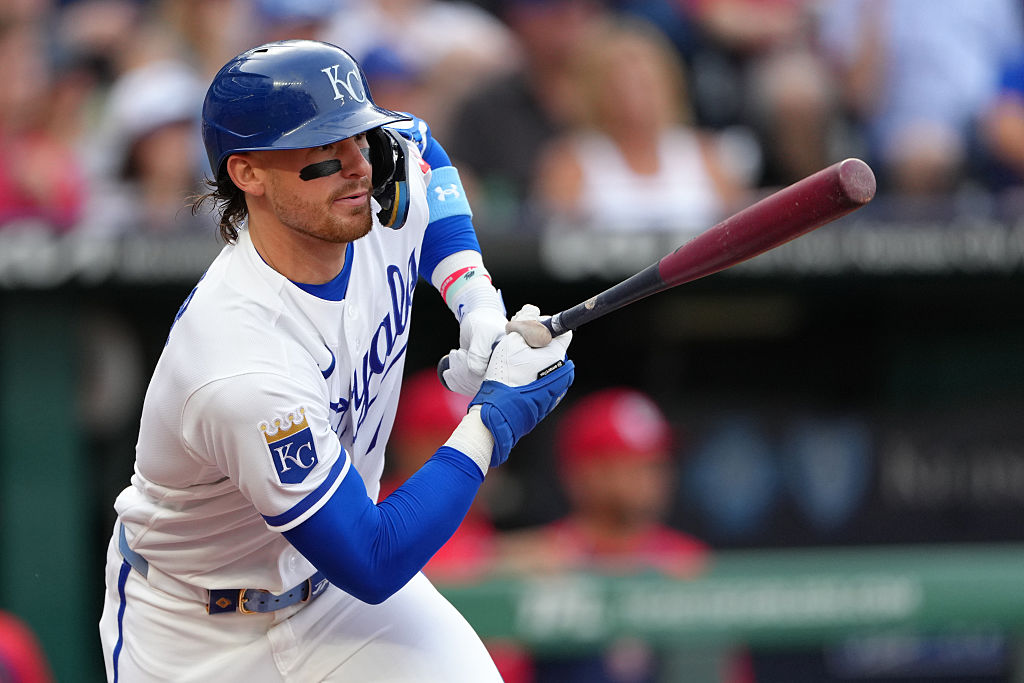
3. Bobby Witt Jr., Royals
He is the league leader in WAR, which carries weight with voters. But Witt’s power numbers are down, and the Royals haven’t played a meaningful game after getting off to a 7-16 start. Witt has hit 10 home runs. No player has won the MVP with a losing team without hitting at least 29 homers (Trout in 2016). All 10 MVPs from losing teams were sluggers, averaging 44.5 home runs.
4. Ben Rice, Yankees
Nice power, but he is tied for 29th in the league in WAR and, with a .211 June, trending downward.
5. Byron Buxton, Twins
At age 32, Buxton is posting his highest SLG in any season with at least 300 plate appearances. But with a .186 batting average with runners in scoring position, Buxton has driven himself in more times (25) than a teammate (18).
6. Junior Caminero, Rays
A potential 40-home run slugger playing third base for a winning team has tons of potential in this field. But Caminero also has huge splits in his OPS at home (1.071) and on the road (.748) and has poor numbers with runners in scoring position (.208).
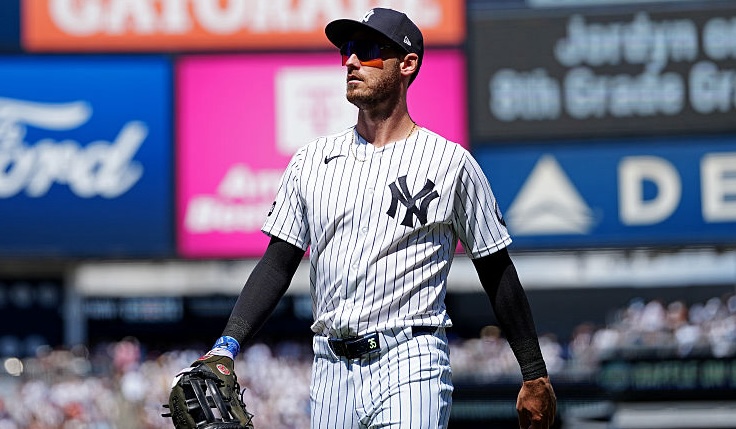
7. Cody Bellinger, Yankees
He has the highest WAR for any player on a winning team. But his home/road OPS splits are shockingly different: 1.128 at Yankee Stadium and .576 on the road.
|
Daniel Shirey/Getty Images
|
Watching Bellinger battle Boston reliever Aroldis Chapman on Saturday was the AI synopsis of how he has evolved as a hitter. After falling behind 0-and-2, Bellinger saw nine more pitches, fouling off five of them with an abbreviated swing as if playing a game of pepper. He became the first hitter this season to foul off four pitches from Chapman at 99.9 mph and faster. The epic at-bat ended with Bellinger taking ball four.
Four years ago, Bellinger struck out 150 times while taking only 38 walks. This year only Bellinger, Kevin McGonigle of the Tigers and Steven Kwan of the Guardians have more walks than strikeouts in the AL.
“First of all, he’s a great athlete, so he’s evolved really well,” Yankees manager Aaron Boone says. “Early on in his career when he won the MVP, he was just such a great athlete, an explosive player. Then he had the shoulder injury, which really messed him up. It affected his swing and obviously affected his performance. But I think he re-invented himself once he got through that. He evolved into a different kind of player, even last year.
“I think his greatest tool is his athleticism, but also with that is the bat-to-ball. He’s got different swings, he can touch everything. This year, he still has the Belli thing in him, that’s special, but he’s walking. That’s been huge.”
And that weird home/road split? Don’t overthink it.
“One of the things that attracted us to him a couple of years ago and this offseason was we thought his swing was made for Yankee Stadium,” Boone says. “So, I do think there’s a component where he’s built for Yankee Stadium. So, I’m not surprised he’s better at home. But I think it’s an anomaly that it’s as big as it is.”
|
Brian Rothmuller/Getty Images
|
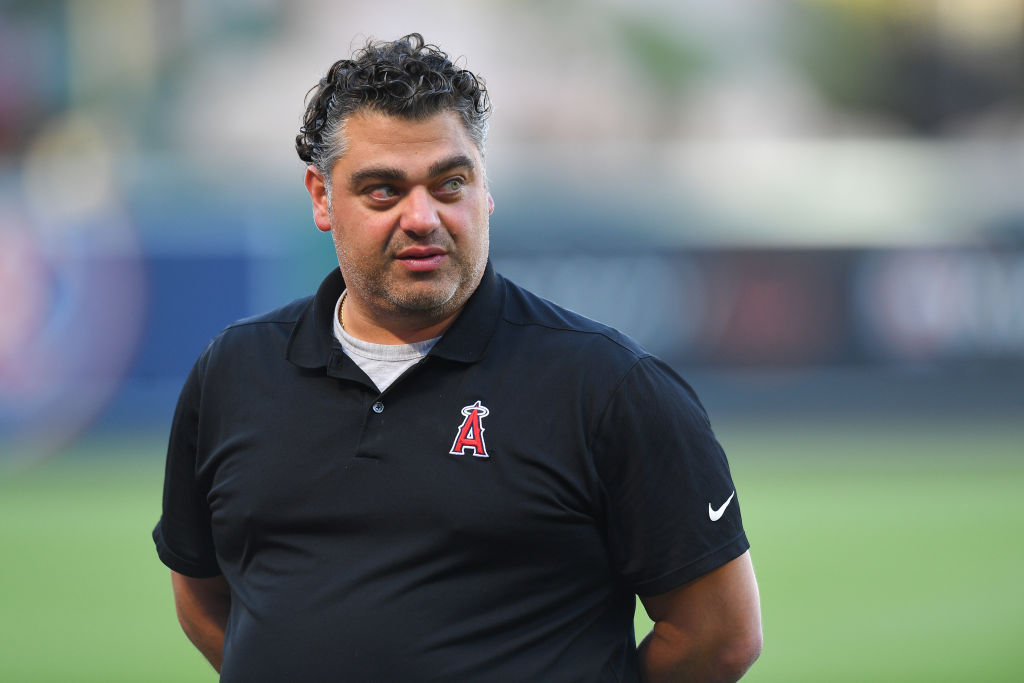
Working for Angels owner Arte Moreno is a challenge. The infrastructure in place in the organization—spring training facility, analytics, player development, scouting—needs modernizing. That said, GM Perry Minasian’s tenure was so disastrous the Angels could not let him stay behind the wheel of another draft and trade deadline cycle. It’s rare to see a baseball operations point person fired midseason, but this could not have been a surprise given his track record.
Minasian was given six seasons, five managers and five top-13 draft picks and somehow left the organization in worse shape than what he inherited. The Angels were 392–500 in his tenure, including the worst team in franchise history, the 99-loss 2024 Angels.
His biggest free agent signings were Yusei Kikuchi, a below average pitcher, Raisel Iglesias, who had a 4.04 ERA before the Angels quickly dumped his salary on Minasian’s old team, the Braves, the oft-injured Robert Stephenson and soft-tossing Tyler Anderson, who went 18–29 with a 4.53 ERA.
Moreno’s disinclination to spend big and a no-deferred-money policy kept top-tier free agents out of reach. But Minasian had a knack for missing on mid-level free agents, never more so than this past winter (Yoan Moncada, Drew Pomeranz, Jordan Romano, Kirby Yates, Alek Manoah).
Outside of shortstop Zach Neto, the farm system has been abysmal. His infamous 2021 draft, in which the Angels took nothing but pitchers, yielded only four big leaguers, none of much importance and a combined 2.6 WAR, or a fraction of the yield of Gavin Williams, taken by Cleveland 14 picks after the Angels took Sam Bachman at No. 9.
This year has been another mess with a hodgepodge of a roster under a rookie manager, Kurt Suzuki, working under the disrespect of a one-year contract. The Angels have cycled through 50 players, the most in baseball, with a fundamentally bad team with an older-than-average roster. Their hitters strike out the most in baseball, their pitchers walk the most batters, their baserunning is the worst in baseball (tied with the Blue Jays and Giants) and their defense is the fifth worst.
Former Cardinals GM John Mozeliak, taking over on an interim basis, is a pro who knows his way around the game and can hit the ground running. For such a bad team, the Angels have made almost no trade deadline deals of significance the past two seasons, except for sending Carlos Estevez to the Phillies. Mozeliak should consider all offers, given there is no foundation in place. He needs to have a discussion with Trout to hear out the franchise player on what his future is with the organization and what needs to be done.
Eventually Mozeliak will get around to finding the next GM, though with a lockout looming, Moreno just might ride through it without a manager or GM in place.
|
Julio Aguilar/Getty Images)
|
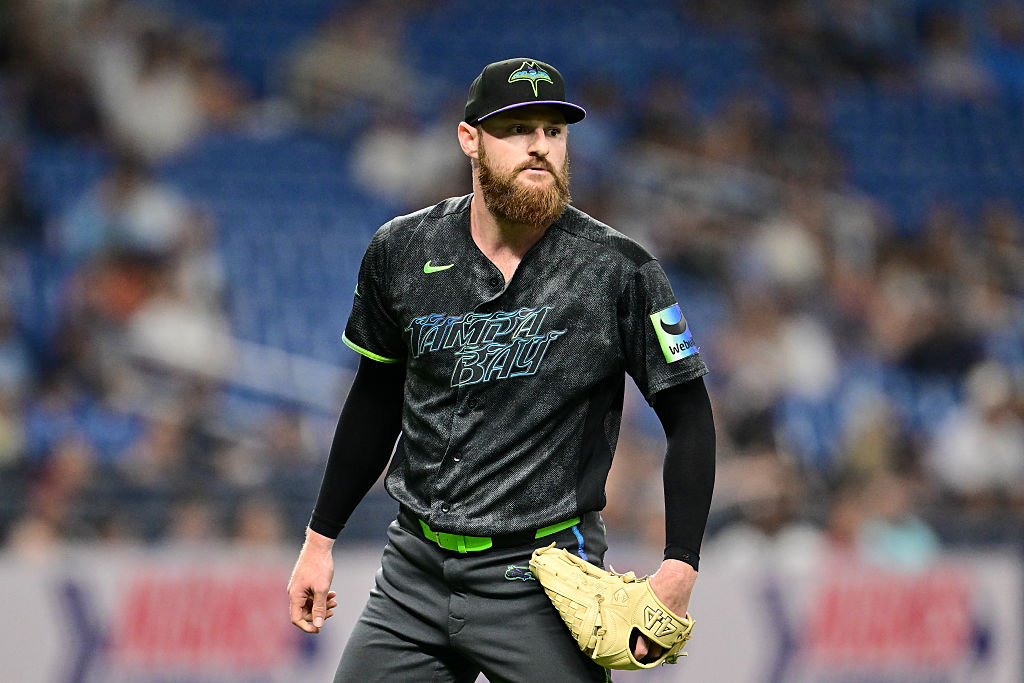
They’ve done it again. The Rays and pitching coach Kyle Snyder keep making pitchers better than they were elsewhere. This time it’s a 31-year-old former 11th round draft pick who was traded twice and waived once. Bryan Baker joined Tampa Bay last July 10 in a trade from Baltimore in which the Rays sent Baltimore the No. 37 pick in the draft. With hardly anyone noticing, the Rays got themselves a power arm with swing and miss stuff and 3 ½ years of control—and a future All-Star selection.
With 21 saves, a 1.95 ERA and a 0.87 WHIP, Baker is deserving of a spot on the AL All-Star team. What did Snyder and the Rays do with Baker? They do what they often do: encourage a pitcher to lean into his best pitch. In this case, it’s been the changeup:
|
| Baker’s Changeup |
AVG |
SLG |
Usage |
| With Baltimore |
.120 |
.136 |
17.1% |
| With Tampa Bay |
.137 |
.275 |
40.6% |
|
Until Baker joined Tampa Bay, his changeup was a great pitch hiding in plain sight. As recently as 2024, Baker was throwing more sliders than changeups. Tampa Bay changed that. This season Baker essentially has stopped throwing the slider (22 this year, only one this month) while boosting his changeup use to 44.9%.
The magic in Baker’s changeup is not so much in the movement but in the separation in velocity from his fastball, especially now that Baker is throwing his heater at a career high of 97.0 mph. There are 50 pitchers who average 97+ mph on their four-seamer. The ones with the greatest gap in velocity between their fastball and changeup are 1. Dylan Cease (13.6 mph) 2. Baker (11.6) 3. Jaden Hill (11.5) 4. Jhoan Duran (11.1) and 5. Jesus Luzardo (10.8).
Baker found the right place to show off his changeup. Led by another Rays renovation project, Nick Martinez, who boosted his changeup rate from 19.8% to 27.9% since joining Tampa Bay, the Rays this season throw more changeups than any team in recorded history.
How is it working? No team this season allows a lower batting average on changeups than the Rays.
|
| Highest Pct. of Changeups, 2008–26 |
Pct. |
Opponents’ AVG |
| 1. 2026 Rays |
20.8% |
.179 |
| 2. 2016 Angels |
20.1% |
.251 |
| 3. 2013 Rays |
19.4% |
.217 |
| 4. 2020 Giants |
19.2% |
.188 |
| 5. 2020 White Sox |
19.1% |
.201 |
|
Just two years ago, Red Sox outfielder Jarren Duran was an All-Star who led the American League in doubles and triples and finished eighth in MVP voting. That player is gone. Now he shows up on this list:
Worst OPS by Qualified Red Sox Outfielder, Since 1920
|
| Player |
Year |
OPS |
| Darren Lewis |
1999 |
.620 |
| Jarren Duran |
2026 |
.622 |
| Tommy Harper |
1974 |
.630 |
| Tom Oliver |
1932 |
.632 |
|
The Red Sox did him no favors this year by not clearing a logjam of similar outfielders that led to a slow start amid sporadic playing time. Then they fired the hitting coaches along with manager Alex Cora.
But Duran, who turns 30 in September, has lost his way as a hitter. Interim manager Chad Tracy says Duran is “caught in between,” code for a hitter who is late on fastballs and early on breaking and off-speed pitches.
Duran relies on athleticism to hit a baseball the way a young Bellinger did. With excellent bat speed, Duran found ways to get his barrel to the baseball even though the mechanics of his swing included big movements and extreme effort. That skill-over-technique methodology doesn’t work so well in today’s game.
Two years doesn’t seem a long time ago, but pitching is evolving incredibly fast. Compare how Duran was pitched in 2024 to how he has been pitched this year:
|
|
|
| Year |
Fastballs Seen |
Avg. FB Velocity |
Breaking & Off-Speed Seen |
Batting Average |
| 2024 |
50.6% |
93.9 |
39.7% |
.252 |
| 2026 |
46.3% |
94.3 |
45.6% |
.156 |
|
Duran is seeing fewer fastballs, increased velocity and a boatload more of non-fastballs. And he is struggling mightily against the increase in spin and off-speed pitches:
Worst BA vs. Non-Fastballs (Min. 500 Non-Fastball)
|
| Player |
Batting Average |
| 1. Dansby Swanson, Cubs |
.098 |
| 2. Manny Machado, Padres |
.132 |
| 3. Brent Baty, Mets |
.148 |
| 4. Salvador Perez, Royals |
.155 |
| 5. Jarren Duran, Red Sox |
.156 |
|
In watching film of Duran, I was struck by how often he changes his approach at the plate. His huge leg kick comes and goes. His hands are high and then they are low. He waggles the bat in the air, and he bounces it on his shoulders. Throughout the swing changes he hits with a lot of head movement, which means his eyes are moving as he is tracking the pitch, which contributes to his trouble with pitch recognition and non-fastballs. What does a struggling hitter look like? Someone without a consistent approach, which you can see below.
Duran might benefit from a change of scenery. His trade value may have plummeted, but he is a good buy-low candidate for a contender.
|
|
|
|
|
|
Get the print edition of Sports Illustrated delivered to your door.
|
|
|
|
|
|
|
We may receive compensation for some links to products and services included in this email.
Sports Publishing Solutions Inc.
625 Broadway, 10th floor
New York, NY. 10012
You are receiving this email because you are subscribed to the Verducci’s View newsletter.
You can unsubscribe here . Privacy Policy – Terms & Conditions
© 2026 Sports Publishing Solutions Inc. All rights reserved.
SPORTS ILLUSTRATED IS A REGISTERED TRADEMARK OF ABG-SI LLC.
All betting and gambling content included in the Verducci’s View newsletter is intended for individuals 21+ (18+ in DC, KY, NH, RI, and WY). Betting and gambling content, including picks and predictions, are based on individual commentators' opinions and we do not guarantee any success or profits. If you or someone you know has a gambling problem, crisis counseling and referral services can be accessed by calling 1-800-GAMBLER or texting 800GAM.
|
Click this link to view the newsletter in your browser.
|
|
|
|











No comments:
Post a Comment